On-device transcription and what it actually means
“Everything happens on your phone” is a claim worth a good interrogation – including when I am the one making it.
Here is the version I am willing to defend: transcribing your videos runs on your device. Apple’s Speech framework exposes requiresOnDeviceRecognition, which forces a recognition request to be handled locally instead of being sent to a server, and reading the text visible in frames uses Vision’s text recognition, which is also local. The index those produce stays on the phone.
On-device is not the same as no network
This is the part most privacy marketing skips, so let me be blunt about it.
An app that transcribes locally can still use the network for other things, and FindMyTok does. It reaches TikTok through the session you open, because that is how it sees your published videos at all. It uses a service for purchase reporting and another for limited analytics. All of that is described in the privacy policy, and I would rather you read the boring document than trust an adjective on a homepage.
What local processing buys you is specific and worth having: the audio of everything you have ever published does not get uploaded to a transcription service to make search work. That is a real difference from the alternative design, and it is not the same as a promise that the app never touches the internet.
In practice, here is what stays on your iPhone:
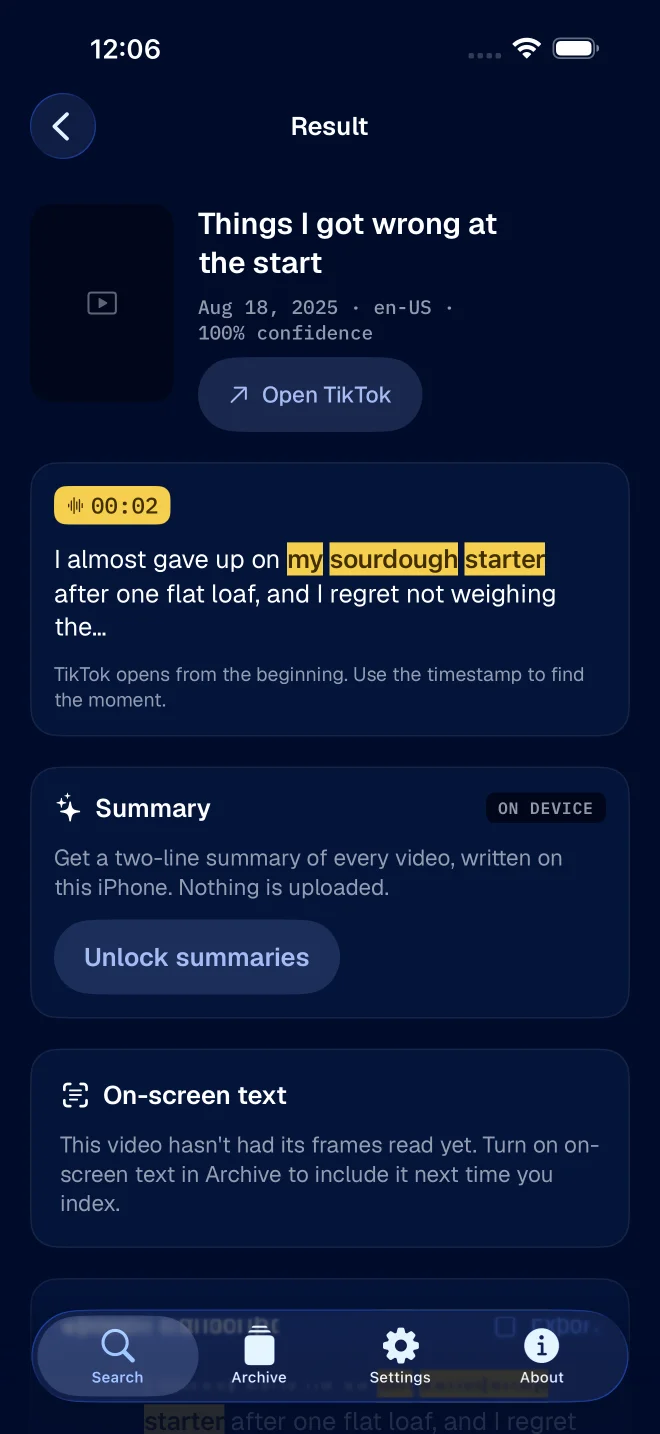
- The transcripts and the text read from frames, in a local database.
- The search index and the thumbnails, with no cloud copy and no sync between devices.
- No leftover media: the downloaded video and the extracted audio are deleted as soon as processing finishes.
Any product that tells you it is completely offline while it needs your social account is telling you something that cannot be true.
Why it matters for this particular data
A transcript of everything you have said on camera for four years is a strange and personal object. It contains names, places, opinions, prices, arguments, and things you do not even remember saying in front of a camera.
And it is more revealing than the videos themselves, because it is searchable. Video is protected by the simple fact that it is tedious to watch. Text is not.
Personally, I would not want that sitting in a third party’s storage, and I do not think you should either. That is the entire argument behind the design.
Context, held to its actual size
Privacy around social platforms stays under active scrutiny. In August 2026 the US Department of Justice announced a settlement with TikTok and ByteDance over children’s privacy, and Brazil’s ANPD fined TikTok R$153.7 million over failures protecting data of children and adolescents.
I want to be careful with those two cases, because it would be easy (and dishonest) to wave them around. Neither case is about transcripts. Neither is about adult users’ published videos. Neither has anything to do with FindMyTok. What they show is that how companies handle stored personal data keeps drawing regulators’ attention – a reasonable backdrop for preferring that a large pile of your own speech never leaves your phone.
The cost of doing it this way
Speed and battery. A data centre transcribes faster than an iPhone, which is why most products choose the server. Indexing a large archive means keeping the iPhone plugged in, with the app open, for a good while.
That is the trade. I think it is the right one for this specific data, and it is worth telling you what it costs rather than pretending the choice is free.
If you would rather have the practical side than the argument, find a TikTok by the words you remember saying shows what all of this is for.